
first, some nah brah business:
I’ll be at Baldwin & Co. on Tuesday speaking at Cleo Wade’s book launch, which is all about loving your neighbor and loving sunrises, so it’s right up my alley. Please come and say hi!

There’s still time to switch your voter registration to “No Party” so you can vote in the Republican Primary (Cassidy v. Letlow) in May! Read more about it here. We’ll talk about it more soon.
Now, on to the business of sunflowers, everyday kindness, and Mardi Gras (aka the important stuff):
“Where you going, Sunflower?” asked a random lady as we walked past each other. She had a cute little smile on her face as she looked me up and down, amused, and I knew I had made the right decision.
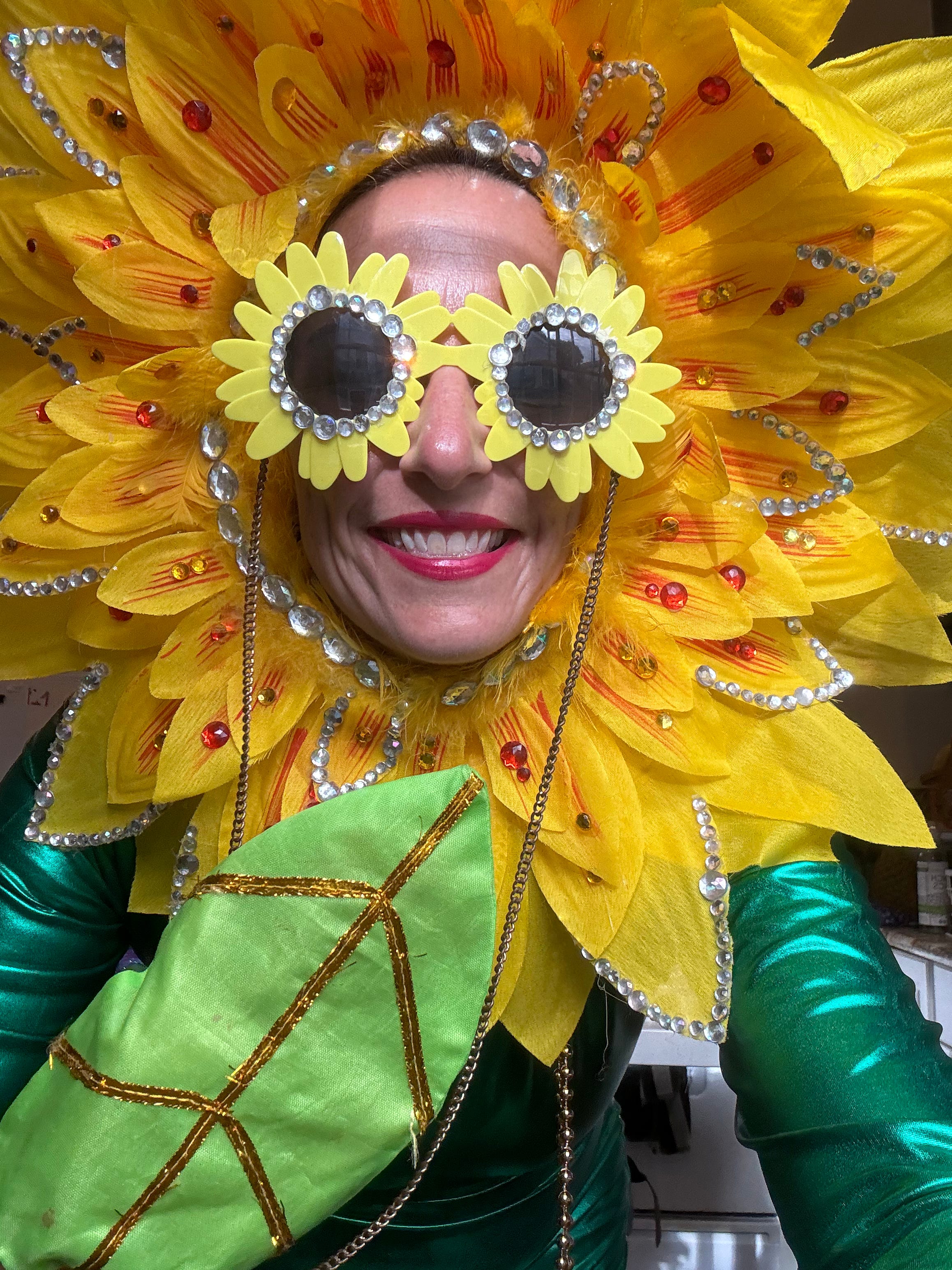
I dressed up as a sunflower on Mardi Gras day—a last minute call this year even though it’s a go-to costume of mine.
I had worn another costume the Friday before as Gregory Bovine-O, which included a full cow onesie, a long green coat, and an udder outfitted with tiny, plastic micro-penises. I had spent the day getting milked by strangers and thought maybe Bovine-O deserved a Fat Tuesday encore but decided to go with the sunflower instead. Partly because I love sunflowers, but mainly because people love sunflowers. And when they see a giant one walking down the street, it instantly softens them, which is something I really enjoy. Turns out I hate getting told to smile, but I love being called Sunshine.
Whenever I dress as a giant sunflower, I spend the day “blooming” up and down the French Quarter and taking pictures with strangers. This year, some lady took a picture of me and told me she was going to put me in her blog—yelled it to me from her porch as I walked down Esplanade. I had actually already passed her house, but she hollered at me to come back and pose for her.
Three years ago, I was walking home at the end of the day, a little tired and a little self-conscious, far away from the fully costumed Quarter crowds and sticking out like a sore sunflower thumb in the heart of Treme. Three ladies were coming down the end of the block, singing and twirling around. I thought they were in their own little world and tried to inch to the edge of it until they all surrounded me and enveloped me in a hug and I realized they were singing to me. You Are My Sunshine.
Sunshine abounds when you’re dressed as a sunflower, and this year I needed it on the heels of three separate Mardi Gras interactions that have stayed with me.

The first interaction was at Muses, or rather, before it started. I went with some friends and their young children (8 and 4). We were way up Magazine where there are no ladders and it’s generally more chill for the children. There was a row of chairs blocking the path from the sidewalk to the street, where the crowd was light before the parade started. We wanted to stand in the street and wait, so we had to scootch our way through the chairs. When scootching through, my friend’s 8-year-old accidentally knocked over a Stanley cup that was perched in the chair’s drink holder. He immediately picked it up and handed it back to the owner, who then threw her drink on him and then, once emptied, threw her cup at him.
That’s when I turned around, alerted by the woman’s drink that had also hit me. The father of the 8-year-old had already placed himself between the woman and his child and was threatening to call the police.
The woman screamed a few things (honestly, I can’t remember what, since my rage temporarily blinded and deafened me) and then left. The two men she was with then stepped in and insisted, belligerently, that the woman had done nothing.
“She didn’t throw her drink at the kid. She didn’t even throw her drink!” they yelled to the woman (me) whose pants were soaked with what I imagine to be a Long Island Iced Tea.
One man took a step closer to me, “Did you even see her throw the drink?” he asked with a smirk on a face I don’t need to describe to you. You already know the look.
“Did you?” I asked, pointing to the wet spot on my pants (not unlike the one on his), “or are you defending something you didn’t even see?”
He paused, confused.
“Are you a lawyer, or something?” he asked, so utterly overwhelmed by such a simple question that he had to assume I had professional training and advanced degrees for having stumped him like that.
The child’s father threatened to call the police again, and I placed my hand on his shoulder.
“It’s not worth it,” I told him. “They’re worthless.”
I turned back to the two men. “You’re worthless,” I said to their blank faces, absent many things, but mostly empathy and curiosity.
We went back to our group, back to the children. Dad sat with his son on the curb, who was crying, thinking he had done something wrong, and explained to him that wasn’t the case.
“She’s just a grumpy old lady,” said the five-year-old daughter to me and her Mom. “I don’t ever want to be a grumpy old lady.”
We each took a hand, formed a circle, and made a pact that none of us would ever become grumpy old ladies. And then we started dancing as the parade started rolling up.
The second interaction was on Sunday, while we waited for Thoth. Again, we were all the way up Magazine, where we have set up for the last several years on Thoth Sunday. This year was a bit more crowded, but we were able to set up behind the sidewalk, and then we (me, Mom, and Dad) assessed the situation.
The kids generally like to go back and forth from the setup to the street. They catch some stuff and then come back to rest and regroup. We, the adults, spread ourselves out in between, to make sure they are safe and comfortable.
Because it was more crowded than usual, and despite the fact that ladders aren’t permitted on that section of Magazine, there wasn’t a clear path from our setup to the street, which was only a matter of three to five feet. Chairs–mostly all empty and placed to save space–lined the street and filled the area between the street and the sidewalk. Because of our Muses interaction, the kids were scared to pick their way around them, so we wanted to have a clear action plan.
Directly in front of our set up was a large tree. The space to the right of the tree was pretty sparsely populated. Maybe three adults and four children, with double that number in empty chairs and plenty of space. They had a long bench placed in the street, with the tree on one side and nothing on the other. Just empty space that wasn’t occupied.
“If they would just move that bench six inches over, we would be able to pass through,” Dad said.
“Maybe I can walk past and just nudge it with my knee,” I said. “Little by little and they won’t even notice.”
”Maybe we can just step over it,” Mom said.
There was a collective “Hmmm” as we all thought of the various ways we could nefariously walk from one public space to another during a free, public community event in our hometown.
“Ok this is ridiculous,” I said. “It’s Mardi Gras! She’s a mom, you’re a mom. Surely, if you explain the situation to her, she’ll have no problem sharing space with your children. Just go talk to her.”
Mom looked doubtful.
”Let’s have faith in the spirit of humanity!” I said. Which is both very typical and very atypical of me in ways I’m sure I don’t need to explain to you.
Mom went. Spoke for a couple of minutes, and then came back shaking her head no.
”No fucking way,” I said. “What did she say?”
”She said she would think about it.”
”That’s fucking wild,” I said as I looked over at the other mom, who was now sitting on the bench, a bench she hadn’t touched for over an hour, stealing furtive glances at us under her “festive” hat while she told her friend what That Mom had the audacity to ask her.
”Absolutely not,” her friend answered. “If she didn’t ask that lady, why does she think she can ask us?” She was referring to a lone woman sitting in a chair, directly in front of the tree.
”We didn’t ask her because there’s a tree there. We can’t walk through a tree. Also because it’s only a couple of inches you aren’t using, but if that’s too much for you to share with a couple of kids, then that’s your decision,” I answered her question, which she did not like. Which I could tell by the way the delicate fringe that ran up and down her hand-died jeans quivered.
The third interaction was immediately after Fringegate.
We need a good neighbor, I thought, looking around.
My eyes fell on a granddad, sitting in a chair directly next to the 4-year-old. Mom had said she felt a tiny bit of resistance from him when they got there, but there he was in his purple, green, and gold overalls that matched his wife’s, who was standing nearby. No way this guy is a downer.
In fact, his entire family had on the same overalls—a giant mass of people who were all spread out to the left of the tree, in a dense maze of occupied chairs that nearly spilled onto the sidewalk and completely blocked the path to the street. All bathed in purple, green, and gold. All speaking our language (Yat). And Grandad was just sitting there proudly, a smile on his face, a patriarch who, along with his matriarch, had brought the whole family together for this glorious Mardi Gras Sunday. And I thought This is the guy. This is our good neighbor.
I crouched next to him and introduced myself. I placed my full faith in him, and I told him about Interaction 1 and Interaction 2. And then I asked him if it would be possible for the kids to cut through their maze to get to the street. I asked him if we could be neighbors for the day.
“Of course,” he said, without hesitation. “I’m John.”
And then he brought all of us over to meet his entire family–including his brand-new grandbaby–and introduced us all by name. ”They’re with us today,” he said. And everyone scootched their chairs over, no more than six inches, to make sure the kids had a path to get through.
John reminded me of something elemental: we have to be good to each other in the good times, too.
You would think that being good to each other in the good times would come the most naturally to us. Yes, of course, it’s Mardi Gras! I’m having a great time! Let me extend my good will to you! Which is obviously something that happens, but John was only one of three interactions–the other two were characterized by suspicion and outright hostility. One out of three isn’t great. I would not buy a toothpaste recommended by only one out of every three dentists.
But also, it kind of makes sense.
We’ve trained ourselves to activate only in moments of crisis, only when urgency demands it. When our neighbors are in trouble, we step in. We help. Of course we do.
Look at Minnesota—an entire state of neighbors activating in the face of an illegal federal crackdown and unimaginable tragedy. The response in Minneapolis has even inspired a term: “neighborism,” coined by Adam Serwer of The Atlantic—the idea that we protect the people around us, no matter who they are or where they came from. It’s a powerful example of how we show up in the bad times.
But what about during the good times? Why do we let our neighborism—our political activism, our civic duty, our communal goodness, our self-care—languish during the good times? Skills left unpracticed, muscles left atrophied. Treated like emergency resources—something reserved for tragedy instead of something that belongs in everyday life. It’s a practice that takes generosity out of rotation and otherizes kindness. Which is convenient in a world order that requires a dearth of such attributes to proliferate.
Listen, I’m guilty of it, too. I’ve framed my entire civic action theory around the idea that you need to get your political house to survive the political shitstorm–aka this moment of tragedy. I even talk about it in terms of hurricane prep–that, as Louisianians, we know in order to help our neighbors in a storm, we have to have our house secured first.
But what if we had had our political house in order during the good times? Before 2016? I’m not saying we could have necessarily prevented the last decade of political distress, because the pendulum always swings back, but maybe it wouldn’t have been so hard to activate. Maybe it wouldn’t have cost us so much if it was just an extension of how we lived instead of an aberration.
We treat civic life (in which I’m including neighborism and self-care) like a HIIT workout—short bursts of extreme effort during extreme moments. This is what’s driving our burnout: it produces quick results, but it isn’t built for endurance.
We need endurance.
Wouldn’t it be so much easier to activate if all those muscles–kindness, generosity, neighborism, civic duty–stayed healthy and in rotation all the time? Then the activation wouldn’t be such a big ask. It wouldn’t be so overwhelming, exhausting, and all consuming. It would just be an extension of who we are. Which, by the way, is what I believe is true for all of us. Even for my first and second Mardi Gras interactions, I believe that humans are inherently kind and generous. We’ve just been conditioned to be scarce with it in the good times.
Being good to each other, ourselves, and our world must be our homebase. It must be where we stand, at all times. Both on the parade route and on the front lines.
It must be where we begin and end.
We all hung around after Thoth. We watched as the crowds thinned and the clean up crew came through and swept the streets.
Usually, I bounce and head straight to Battle of the Bands, but this time I stayed. I lingered in the moment. The kids running around, playing with all their new Mardi Gras throws. John and his wife slow dancing in the street, the shirt under his overalls mysteriously gone. His kindness still intact. And I thought about what the 4-year-old said while we were walking back to the car after Muses. After we had managed to have a beautiful night after such a rocky start.
She had skipped ahead of us and pointed out the Mardi Gras decorations on a house nearby. ”Mardi Gras is to have fun and be kind,” she said. Maybe more to herself than anyone else. And I think maybe she nailed it.
I needed the reminder. I needed the softening. I do not relish telling strangers they are worthless. I do not want to think first of how to trick people into sharing space. I prefer to have faith, even if misplaced at times.
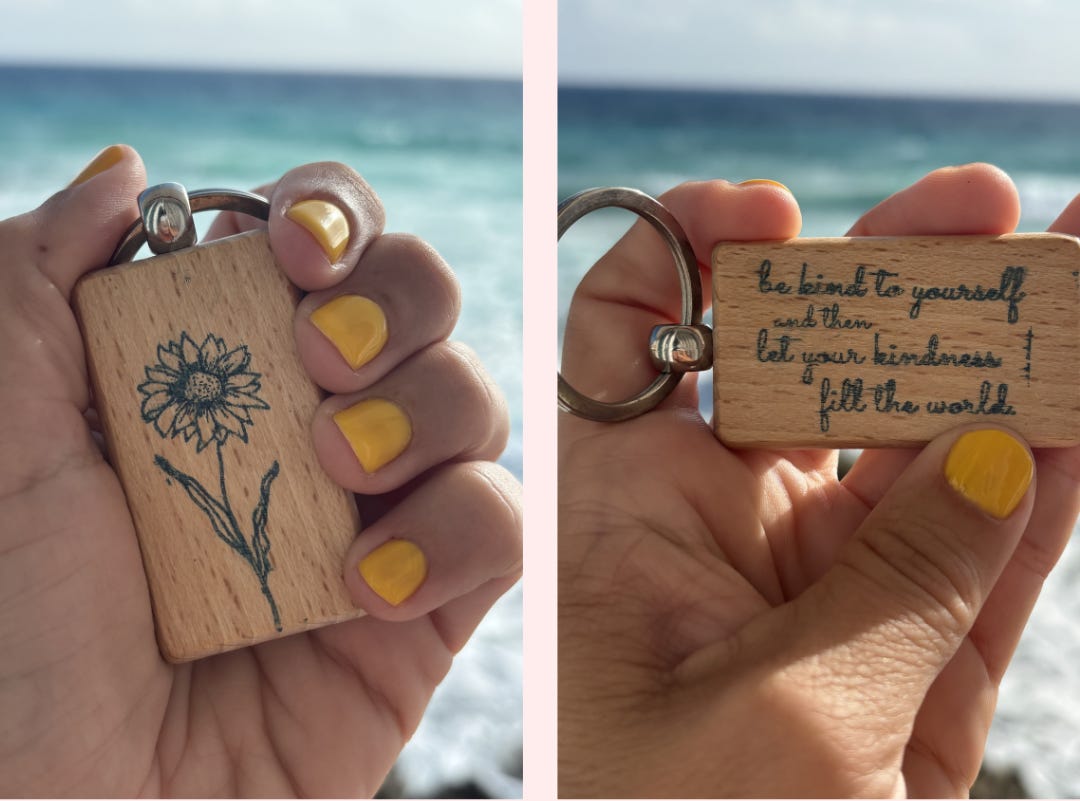
I met another giant sunflower early on Mardi Gras day. He floated past in the Saint Ann parade and then circled back to me. He gave me a sunflower and a key chain–a small, wooden block with a picture of a sunflower on one side and a message on the other:
be kind to yourself
and then
let your kindness
fill the world
That sounds good, doesn’t it?